
These structural differences directly influence image uniformity, protection level, serviceability, and overall investment cost.
In practical applications, SMD remains the economical all-round solution with high production maturity and excellent serviceability. GOB is the ideal choice for high-traffic or demanding environments where impact resistance, reduced maintenance, and environmental protection are more important than achieving the absolute highest image uniformity. COB represents the premium solution for ultra-fine pixel pitches, exceptional image smoothness, high contrast performance, and long-term 24/7 operation at close viewing distances.
There is therefore no universally “best” technology. The correct choice depends on viewing distance, environmental conditions, budget, and maintenance strategy.
SMD LED Modules
SMD stands for Surface Mounted Device. In this design, pre-packaged LED components are mounted directly onto the circuit board. In direct-view LED systems, these are commonly 3-in-1 RGB components. The technology has been industrially established for many years, is highly optimized through automated SMT production processes, and is available across a broad range of indoor and outdoor LED solutions.
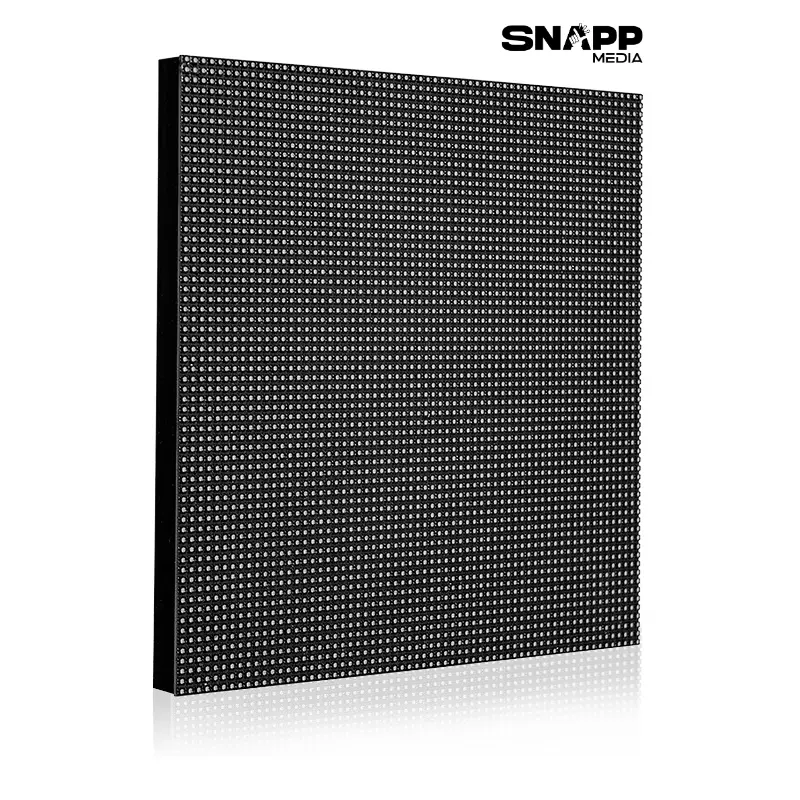
Modern commercial SMD systems typically offer wide viewing angles, high brightness levels, and long operational lifespans. At the same time, the technology supports a wide spectrum ranging from standard LED applications to fine-pitch displays.
The major advantage of SMD lies in its versatility. The technology is scalable, production-efficient, and economically attractive for many projects. For large-format display surfaces, digital signage, conference rooms, retail environments, information systems, and numerous outdoor installations, SMD is often the most practical solution.
Another key benefit is serviceability. The modular design is traditionally considered repair-friendly because faults can often be addressed at module or component level. This combination of market availability, strong price-performance ratio, and service flexibility is what continues to make SMD the foundation technology of many LED display projects.
Its limitations become more noticeable in applications with extremely short viewing distances or environments with high mechanical stress. Since individual LED packages remain visible on the PCB surface, ultra-high-resolution close-view applications can appear more structurally defined compared to COB technology.
Without additional protection measures, the front surface is also generally less resistant to dust, moisture, and physical contact. As a result, standard SMD systems often have lower protection ratings than sealed GOB or COB solutions. While SMD can still support ultra-fine pixel pitches, COB is generally considered more technologically refined for these applications.
GOB LED Modules
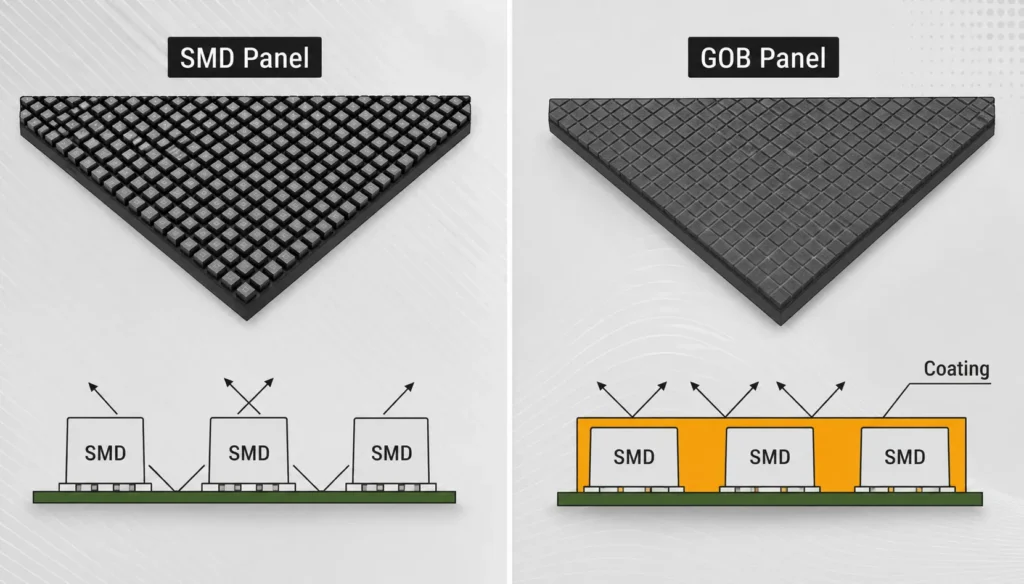
GOB stands for Glue on Board. In the LED display industry, GOB is typically not a completely separate LED architecture like SMD or COB, but rather a protective enhancement applied to an existing LED module — usually an SMD module.
A transparent epoxy resin layer is applied across the module surface, filling gaps and sealing the LED components. According to manufacturers, this protective layer does not significantly affect brightness or color performance. At the same time, it creates a protective barrier that stabilizes the visual surface and can reduce reflections and glare.
The strength of GOB lies in its durability. The sealed surface significantly improves resistance against dust, moisture, impact, and in some cases even static electricity compared to standard exposed SMD modules.
In environments such as shopping centers, lobbies, transportation hubs, educational facilities, and other high-traffic areas, GOB technology reduces the risk of damage while lowering cleaning and maintenance requirements. For this reason, GOB is consistently positioned as a solution for public facing installations.
Modern GOB systems often provide front protection ratings such as IP54 and impact resistance classifications like IK06. At the same time, they maintain high visual quality with wide viewing angles, excellent daily usability, and a much more maintenance-friendly surface.
Because GOB is typically based on SMD architecture, part of the SMD characteristic remains. The protective layer improves durability and practicality, but it does not transform an SMD module into a true COB module.
For extremely short viewing distances and ultra-fine pixel pitches, COB still maintains a technological advantage because GOB continues to rely on separate LED packages. Repairability is also more complex: while routine maintenance and cleaning become easier, localized pixel repair may be more challenging due to the sealed surface layer.
Additionally, the encapsulation process increases manufacturing complexity compared to standard SMD production, although GOB generally remains more accessible than full COB manufacturing.
COB LED Modules
COB stands for Chip on Board. Unlike SMD, where packaged LEDs are mounted onto the PCB, COB mounts the RGB chips directly onto the substrate itself.
This approach significantly increases pixel density while creating a flatter and more homogeneous display surface. Extremely fine pixel pitches can therefore be achieved much more efficiently.
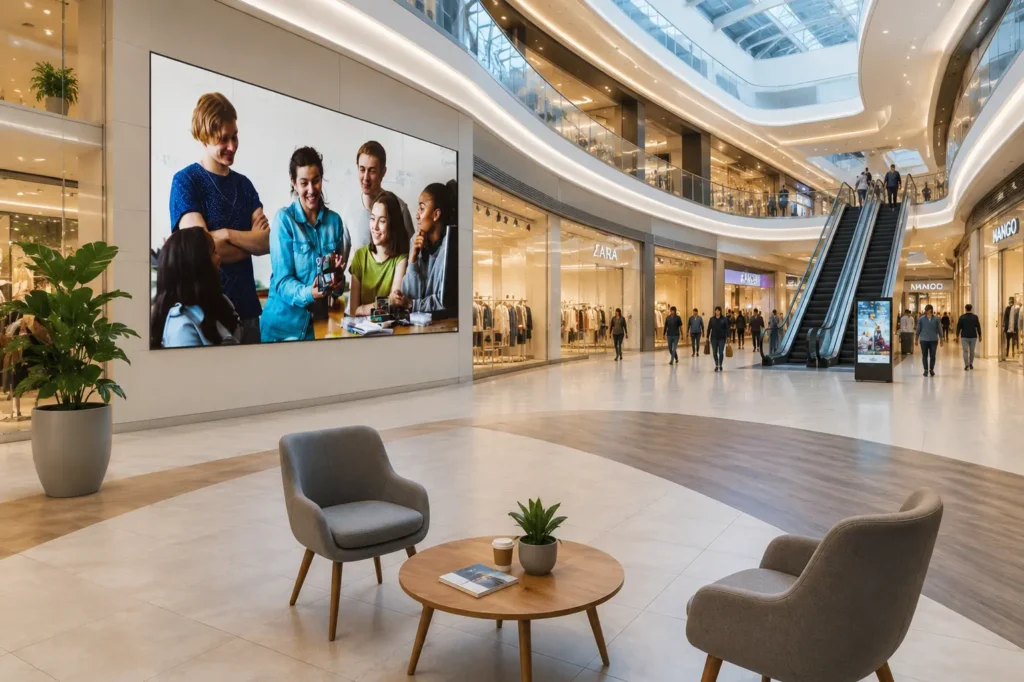
Modern COB architectures frequently use advanced technologies such as flip-chip concepts or bonding wire-free designs, providing additional advantages in density, durability, and thermal management.
The visual impact is immediately noticeable. COB minimizes visible gaps between pixels, reduces the granular appearance of fine-pitch displays, and improves image uniformity. The technology is also commonly associated with higher contrast ratios, deeper black levels, and excellent viewing angles.
For this reason, COB excels in applications where close viewing distance, fine detail, and exceptional image smoothness are critical — such as control rooms, corporate environments, broadcast studios, showrooms, and other premium indoor installations.
Modern COB systems frequently feature ultra-fine pixel pitches, high contrast performance, wide viewing angles, and increased front protection against impact and environmental exposure.
Another major advantage of COB is thermal performance. Because the chips are directly connected to the thermally conductive substrate and require fewer traditional solder connections, heat can be dissipated more efficiently.
This is particularly important for 24/7 operation, long-term stability, and low failure rates, since LED lifespan is heavily influenced by junction temperature. As a result, COB is commonly associated with high reliability, long operational lifespan, and reduced routine maintenance costs.
The trade-off for these advantages is higher manufacturing complexity. COB production requires greater precision, stricter quality control, and more advanced production processes. Yield optimization and packaging complexity can increase overall production cost.
Serviceability must also be considered differently. Modern COB systems do support front service and module replacement, but pixel-level repair is generally more demanding compared to traditional SMD systems.
In other words, COB is not difficult to maintain, but its maintenance philosophy is more modular and system-oriented rather than component-oriented.
Comparing SMD, GOB, and COB
When selecting the right LED technology for a project, three main questions should be considered:
Pixel pitch directly determines pixel density and therefore the optimal viewing distance. Smaller pixel pitches enable closer viewing distances but also increase cost and manufacturing precision requirements.
Current market trends show that COB technology generally extends deeper into ultra-fine pixel pitch ranges than GOB, while SMD covers the broadest range of standard and fine-pitch applications.
The following matrix summarizes the typical characteristics of each technology.
| Criteria | SMD | GOB | COB |
Image Quality | Excellent across many applications; more visible structure at close range | Very good; smoother and less reflective surface | Exceptional close-view image quality with highly uniform appearance |
Pixel Pitch & Density | Broad range from standard to fine pitch | Fine to medium pitch; still SMD-based | Excellent for ultra-fine pixel pitches and maximum density |
| Viewing Angle | Wide | Wide to very wide | Very wide |
Brightness | Highly flexible; strong in standard and outdoor applications | High; durability prioritized alongside brightness | High with excellent uniformity |
Contrast | Good to very good | Very good with smoother surface | Extremely high with deeper black levels |
Durability | Medium without additional protection | High to very high | High to very high |
Moisture & Dust Resistance | Lower without additional protection | Significantly improved through sealed surface | Significantly improved through integrated encapsulation |
Repair & Maintenance | Most field-service-friendly | Lower routine maintenance; local repairs more complex | Lower routine maintenance; repairs more module-based |
Heat Dissipation | Proven and reliable | Depends on sealing process | Typically superior due to direct chip connection |
Lifespan | Long | Long with improved environmental protection | Long with strong thermal stability |
Cost | Usually, the most affordable | Medium | Highest |
Strengths and Weaknesses Overview
| Technology | Strengths | Weaknesses | Best Suited For |
SMD | Mature technology, strong price-performance ratio, broad product range, repair-friendly, highly flexible | Lower front protection without additional measures; less homogeneous than COB at close range | Standard LED projects, retail, conferences, events, outdoor installations |
GOB | Sealed surface, high resistance against impact, dust, and moisture; reduced maintenance | Still based on SMD; local repairs more complex; not ideal for ultra-high pixel density | Public-facing installations, transportation, education, shopping centers, robust indoor environments |
COB | Highest pixel density, extremely smooth image, superior contrast, excellent thermal management, premium visual quality | Higher investment and manufacturing cost; repairs are more modular than pixel-based | Premium indoor installations, control rooms, broadcast, showrooms, luxury brand environments |
Final Conclusion
In summary, SMD is the economical all-round solution, GOB is the specialist for durability and protection, and COB is the premium technology for maximum close-range image quality.
Understanding these differences creates clarity during project planning and allows technology consultation to become real added value for the customer.
Whether Indoor LED Walls, Outdoor LED Screens, Fine-Pitch LED Displays, COB LED, GOB LED, or classic SMD LED modules , SNAPP MEDIA delivers modern digital signage and professional LED display solutions for businesses, retail stores, showrooms, shopping centers, hotels, events, conference rooms, public viewing areas, control rooms, and advertising spaces of all sizes.
Our focus is always on outstanding image quality, high brightness, energy efficiency, long lifespan, and professional consultation. From planning and installation to maintenance and technical support, SNAPP MEDIA accompanies every project with extensive expertise and years of experience in professional LED systems.
If you are looking to buy a high-quality LED display, rent an LED wall, or implement a customized digital signage solution for your business, SNAPP MEDIA supports you with cutting-edge technology and personalized consultation.