
LED Modules with SMD, GOB and COB Compared
SNAPP MEDIA
SMD, GOB and COB are often mentioned in the same breath, but technically they are not the same thing. SMD is the established surface-mount design, with individually packaged LED components placed on the circuit board. In the display world, GOB is usually an additional protective coating applied to an SMD module, where a transparent epoxy resin layer seals the surface. COB goes one step further and mounts the RGB chips directly onto the substrate, which allows a much higher packing density and a smoother, more uniform light surface. These differences drive the key distinctions in image smoothness, protection, serviceability and level of investment.
In practice this means: SMD remains the cost-effective all-rounder, with mature manufacturing and easy servicing. GOB is the particularly robust answer for installations that are close to the public or exposed to wear, where impact resistance, lower maintenance and environmental resistance matter more than the last bit of uniformity. COB is the premium solution for very fine pixel pitches, a calm image, strong contrast and durable 24/7 applications viewed from a short distance. There is therefore no single “best” technology; the right choice depends on viewing distance, environmental conditions, budget and service concept.
SMD LED modules
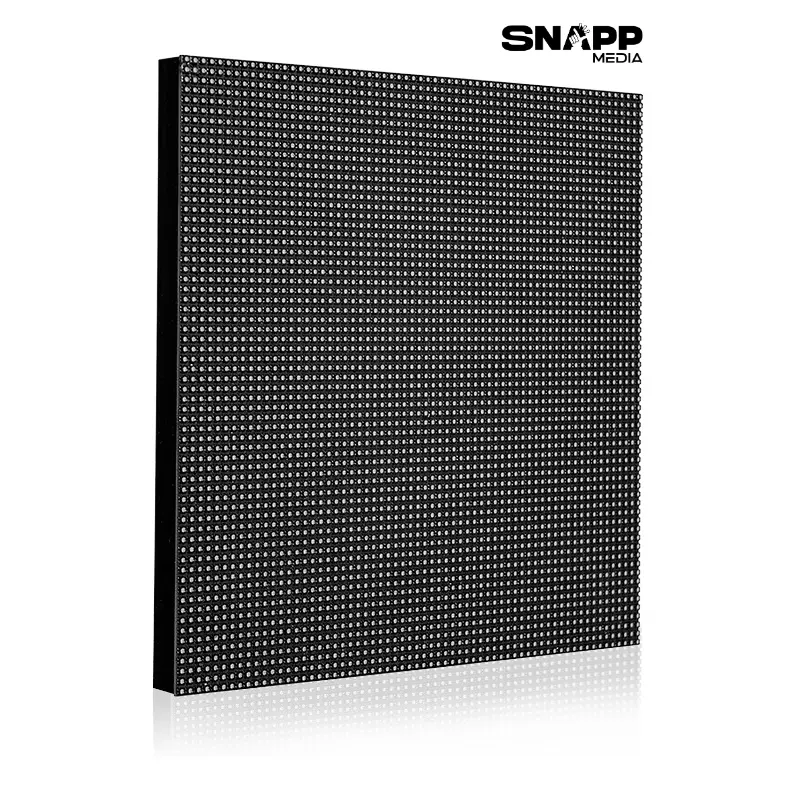
SMD stands for Surface Mounted Device. In this design, pre-packaged LED components are placed directly onto the circuit board; in direct-view LED systems these are often 3-in-1 RGB components. The technology has been industrially established for years, is well controlled in automated SMT processes and is available across a very wide range of indoor and outdoor solutions. Depending on the design, current commercial SMD systems typically offer wide viewing angles, high brightness and very long nominal operating lives, and the available range runs from standard to fine-pitch solutions.
The great advantage of SMD is its versatility. The technology is produced at scale, mature in manufacturing and economically attractive in many applications. For large-format image surfaces, classic digital signage projects, conference rooms, retail spaces, information systems and many outdoor installations, SMD is often the most pragmatic solution. In addition, its modular design is traditionally considered comparatively easy to repair in the field, because defects can often be addressed at module or component level. This combination of market availability, price-performance ratio and service logic is what still makes SMD the base technology of many LED projects.
SMD shows its limits mainly where viewers come very close to the surface or where the surface is exposed to heavy mechanical stress. Because individual LED packages sit on the circuit board, structures between the light points and packages tend to remain more visible in very high-resolution close-up applications than with COB. Without additional protection, the front is also typically less protected against dust, moisture and touch; current SMD specifications therefore often show lower IP ratings than sealed GOB or COB versions. Ultra-fine pixel pitches are still possible with SMD, but usually less elegant and technologically less advantageous than with COB.
GOB LED modules
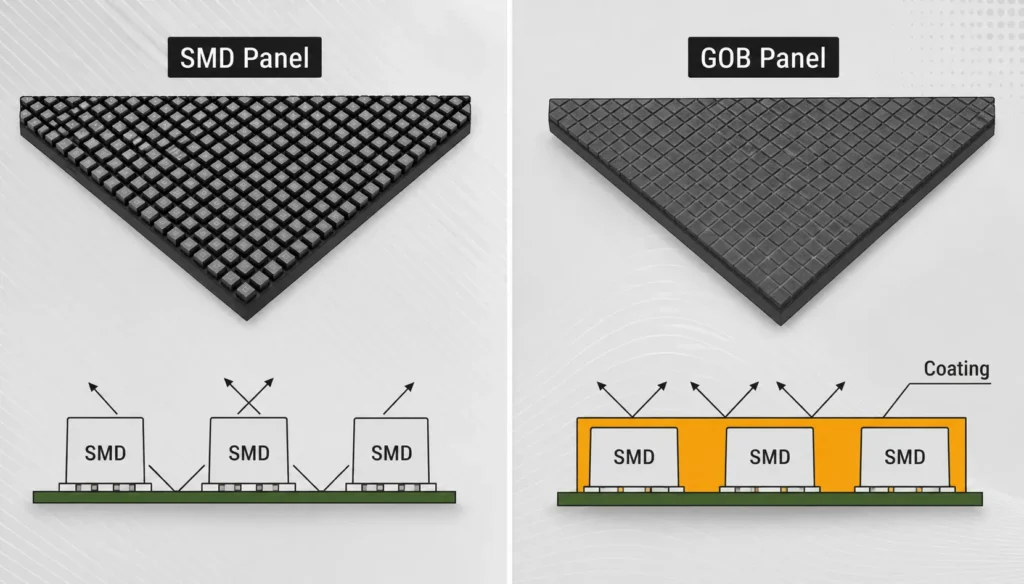
GOB stands for Glue on Board. In the display market this is generally not a completely independent LED structure like SMD or COB, but a protective finish applied to an already assembled LED module, usually an SMD module. A transparent epoxy resin layer is applied over the module surface, filling the gaps and sealing the components; according to manufacturers, it is not supposed to significantly affect brightness or colour reproduction. This layer acts as a protective barrier and can also calm the surface visually and reduce glare.
The strength of GOB is its robustness. Thanks to the sealed surface, dust, moisture, mechanical impact and, in some descriptions, static loads are absorbed much better than with open SMD. Especially in foyers, shopping centres, transport hubs, educational facilities and other high-traffic spaces, this reduces the likelihood of damage and lowers cleaning and maintenance effort. Manufacturers therefore consistently position GOB as a solution for high-traffic areas; current commercial systems often show front-side protection ratings such as IP54 and impact ratings such as IK06. At the same time, visual performance remains high, with wide viewing angles, good everyday usability and a front that is much easier to care for.
Precisely because GOB is usually built on SMD, part of the SMD character remains. The protective layer increases protection and everyday usability, but it does not turn an SMD module into a true COB module. For very short viewing distances and extremely fine pixel pitches, COB therefore keeps the advantage, because GOB still works with separate LED beads. GOB is also a double-edged concept when it comes to repairs: routine maintenance and cleaning become easier, but local rework on individual pixels can be more complex than with bare SMD because of the sealed surface. The coating also adds process effort compared with standard SMD, although GOB, thanks to its SMD base, usually remains considerably more accessible than full COB manufacturing.
COB LED modules
COB stands for Chip on Board. Unlike SMD, the RGB chips are not first packaged individually and then soldered on, but placed directly onto the substrate or circuit board. This increases packing density considerably, makes the surface flatter and more uniform, and makes very small pixel pitches much easier to achieve. Current COB architectures often use bonding-wire-free or flip-chip concepts, which bring additional advantages in density, robustness and thermal connection.

The effect on the image is immediate. COB reduces visible gaps, lessens the grainy impression of fine-pitch displays, improves uniformity and is regularly associated by manufacturers and industry sources with higher contrast, deeper blacks and very good viewing angles. That is why COB is particularly strong where close viewing, fine detail and visual calm are decisive, for example in control rooms, corporate environments, broadcast, showrooms and other premium indoor applications. Current commercial COB systems also frequently offer very fine pixel pitches, high contrast values, wide viewing angles and increased front-side protection and impact resistance.
Another core advantage is thermal behaviour. Because the chips are connected more directly to the thermally conductive substrate and fewer classic solder or connection points are needed, COB can dissipate heat more efficiently and control thermal load better. This is relevant for 24/7 operation, long-term stability and low failure rates, because LED lifetime depends strongly on junction temperature. In practice, COB is therefore often associated with high reliability, a long nominal lifetime and lower routine maintenance costs, although actual performance always depends on the overall design of the system.
The other side of these advantages is the higher manufacturing demand. Technical literature and manufacturer sources describe COB as more precision-intensive in production and quality control; in early and partly also in current versions, yield, process quality and packaging complexity drive up costs. Service also needs a differentiated view: modern systems do offer front service and module-based replacement, but repairing individual chips at pixel level is generally more involved than with classic SMD. In other words: COB is not unserviceable, but its maintenance logic is modular and system-based rather than component-based.
Comparing SMD, GOB and COB
Three questions matter most when choosing for a project: How close does the audience stand to the surface? How much mechanical or climatic stress does the surface face? And how important is fast, low-cost field maintenance? Pixel pitch directly determines pixel density and therefore the sensible viewing distance; the smaller the pitch, the closer the viewer can be, but costs and precision requirements typically rise as well. Current manufacturer portfolios also show that COB is generally offered further into ultra-fine pitch ranges than GOB, while SMD covers a particularly wide field from standard to fine-pitch applications.

The following matrix condenses typical market tendencies. It is deliberately formulated at technology level and not tied to individual models. In practice, brightness, contrast, viewing angle, energy efficiency and protection rating also depend on driver architecture, calibration, black masking, common-anode or common-cathode topology, coating quality and the overall design of the system. The table therefore does not show absolute laws, but reliable directions as they can be derived from manufacturer documentation, industry articles and technical literature.
| Criterion | SMD | GOB | COB |
Contrast | Good to very good | Very good, especially with a calmer surface | Very high; often associated with deeper blacks |
Robustness | Medium without additional protection | High to very high | High to very high |
Moisture and dust resistance | Lower without additional protection | Significantly increased by the sealed front | Significantly increased by integrated encapsulation |
Repair and maintenance | Usually the most field-friendly | Low routine maintenance, but local repair is more complex than with SMD | Low routine maintenance; repair is often a module rather than a pixel matter |
Heat dissipation | Proven, but less elegant than COB at high density | Depends on process and material; the protective layer affects thermal behaviour | Usually at an advantage thanks to direct chip connection and lower thermal resistance |
Lifetime | Long | Long; protection reduces failure risks in everyday use | Long; good thermal behaviour and fewer classic weak points have a stabilising effect |
| Cost | Usually the lowest | Usually mid-range | Usually the highest |
Manufacturing complexity | Mature, scalable, cost-efficient | SMD plus an additional coating and curing process | Highest precision and quality control required |
Suitable applications | Classic indoor and outdoor LED, DOOH, events, retail, information | Public indoor spaces, transport, education, areas close to the public, robust installations | Premium indoor, control rooms, broadcast, showrooms, high-quality close-up applications |
From SNAPP MEDIA’s point of view, the short version is this: SMD is the best choice when investment security, broad availability and ease of service come first. GOB is the logical answer when displays can be touched, are exposed or are maintenance-sensitive. COB is the most convincing solution when the image surface needs to look flawless, high in contrast and extremely stable over the long term, even from a short distance.
Strengths and weaknesses at a glance
The following table condenses the decision to the essentials and summarises the technical and market-typical differences described above.
| Technology | Strengths | Weaknesses | Particularly suitable for |
SMD | Mature technology; strong price-performance ratio; wide product range; good field repair; flexible for many indoor and outdoor projects | Less front protection without additional measures; less uniform than COB at close range; technologically less elegant at ultra-fine pitch | Standard LED projects, DOOH, retail, conference, events, many outdoor applications |
GOB | Sealed surface; high resistance to impact, dust and moisture; less cleaning and maintenance; well suited to everyday use in public areas | Still SMD-based; local repairs more complex than with open SMD; usually not the first choice for the highest pixel densities | Installations close to the public, transport, education, foyers, shopping, robust indoor surfaces |
COB | Highest packing density; very calm image; high contrast; strong thermal behaviour; high reliability; ideal for premium close-up viewing | Higher manufacturing and investment effort; service is modular rather than pixel-level; often oversized for budget projects | Premium indoor, control rooms, broadcast, showrooms, high-quality corporate and brand spaces |
Condensed into one last sentence, the picture is clear: SMD is the economical all-rounder, GOB the robustness specialist and COB the premium solution for maximum image quality at close range. This distinction brings clarity to any buying decision and turns technical advice into real added value for the customer.
Choosing the right LED technology today determines image quality, reliability, maintenance effort and long-term investment security. This is where SNAPP MEDIA comes in: we analyse every project individually and offer our customers the optimal LED solution with the greatest care, matched to the application, viewing distance, budget and design requirements.
Whether indoor LED wall, outdoor LED screen, fine-pitch LED display, COB LED, GOB LED or classic SMD LED modules: SNAPP MEDIA supplies modern digital signage and LED display solutions for companies, retail, showrooms, shopping centres, hotels, events, conference rooms, public viewing, control rooms and advertising spaces of any size.
Image quality, high brightness, energy efficiency, long lifetime and professional advice are always the focus. From planning and installation to maintenance, SNAPP MEDIA supports every project with technical know-how and many years of experience in professional LED systems.
If you want to buy a high-quality LED display, rent an LED wall or realise a tailor-made digital signage solution for your company, SNAPP MEDIA supports you with state-of-the-art technology and individual advice.

Next-generation digital advertising.