
P1.25, P2.5, P4: anyone looking into LED walls quickly comes across these values. They describe the pixel pitch, one of the most important decisions when planning. It determines how sharp the picture looks up close, how high your LED wall’s resolution is, and a large part of the price. In this article we explain what the numbers mean and how to find the right value for your space.
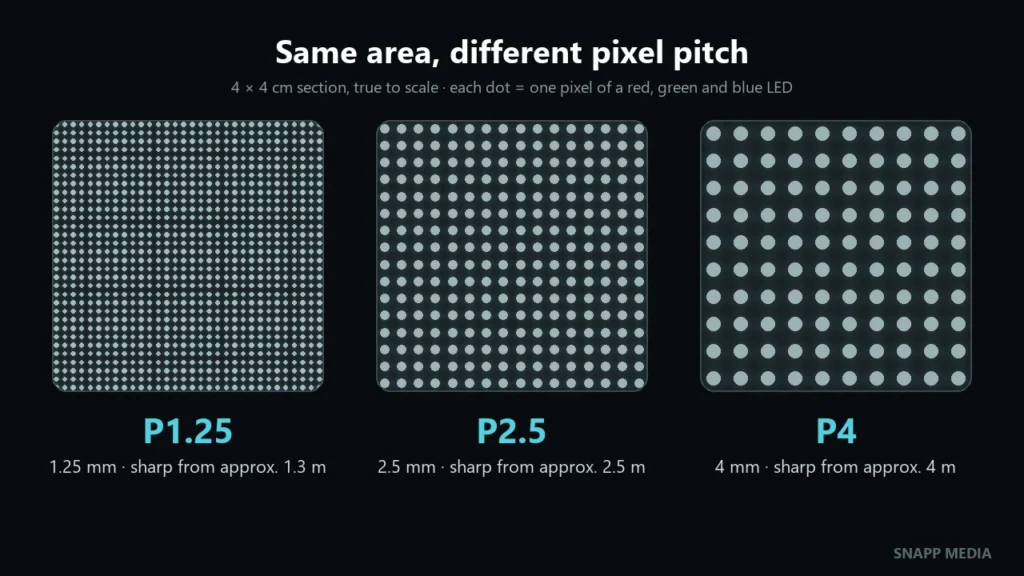
An LED wall is made up of many small points of light, the pixels. Each pixel consists of a red, a green and a blue LED. The pixel pitch is the distance from the centre of one pixel to the centre of the next, measured in millimetres. The “P” in P2.5 stands for exactly that: with P2.5, the pixels are 2.5 mm apart.
The smaller the value, the closer together the pixels sit, the finer the picture looks and the closer you can stand without seeing individual dots.
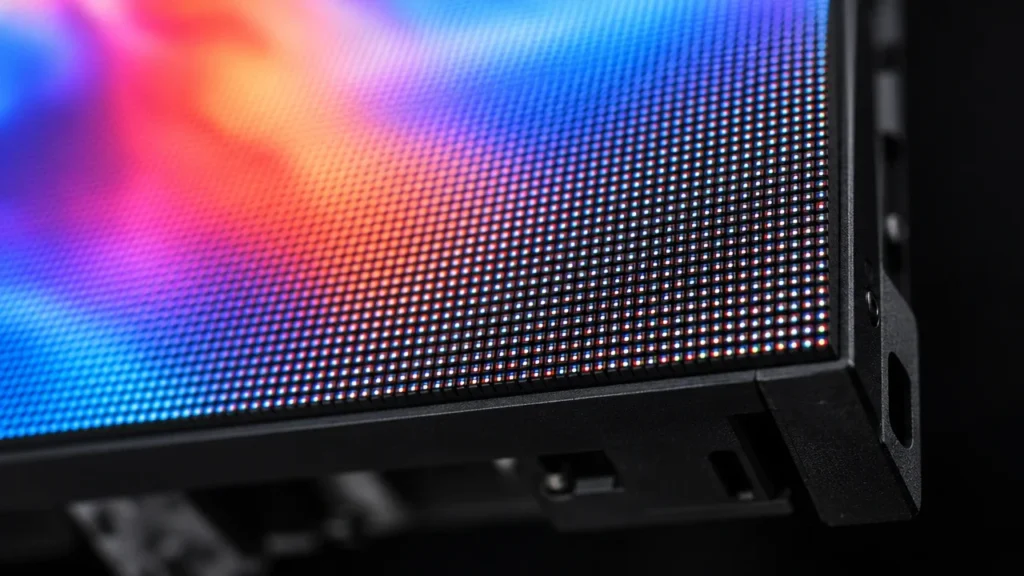
For everyday use there is a simple rule of thumb: the shortest comfortable viewing distance in metres roughly equals the pixel pitch in millimetres.
Closer than that, you start to see individual pixels. Further away, you see a closed, sharp picture. What matters is not how close someone could theoretically get to the LED wall, but from what distance most people actually look at it.
Our D-series indoor LED modules all share the same module size of 320 × 160 mm. The smaller the pixel pitch, the more pixels fit on one module.
| Model | Pixel pitch | Resolution per module | Pixels per m² | Viewing distance from |
|---|---|---|---|---|
| D1.25 | 1.25 mm | 256 × 128 | 640,000 | 1.3 m |
| D1.53 | 1.538 mm | 208 × 104 | 422,500 | 1.6 m |
| D1.86 | 1.86 mm | 172 × 86 | 288,906 | 1.9 m |
| D2 | 2 mm | 160 × 80 | 250,000 | 2 m |
| D2.5 | 2.5 mm | 128 × 64 | 160,000 | 2.5 m |
| D3 | 3.076 mm | 104 × 52 | 105,625 | 3 m |
| D4 | 4 mm | 80 × 40 | 62,500 | 4 m |
The table shows an important point: on the same area, an LED wall with P1.25 has more than ten times as many pixels as one with P4. More pixels mean more LEDs and therefore a higher price.
An LED wall’s resolution follows from its size and pixel pitch. Take a wall of 10 × 10 modules, i.e. 3.2 m wide and 1.6 m high:
At P1.25 this wall has more pixels than a Full HD screen (1920 × 1080). At P2.5 the resolution is lower, but from 2.5 m and further the picture still looks sharp. This matters when planning your content: videos and graphics should be created in the LED wall’s format.
No. A smaller pixel pitch only brings a visible benefit if people actually stand close enough. An LED wall above a counter, usually seen from three to five metres, does not need P1.25. The difference would be hard to see from that distance, but the price would be much higher. We explain how strongly pixel pitch affects the price in our article “LED Wall Cost: What Determines the Price?”.
Conversely, if there is a lot of small text to read, such as tables, dashboards or menus, a slightly smaller pixel pitch than the rule of thumb alone suggests is worth it.
The following overview is meant as a guide. We set the exact value together with you after we have seen the space.
| Use | Typical viewing distance | Guide |
|---|---|---|
| Meeting room, reception | 1–3 m | P1.25 to P1.86 |
| Sales floor, showroom | 2–4 m | P2 to P3 |
| Restaurant, LED wall above the counter | 3–5 m | P2.5 to P4 |
| LED poster at the entrance | from 2.5 m | P2.5 |
| Transparent display in the shop window | depends on distance to the street | P3.5 to P10 |
| Facade, outdoor advertising | long distance | larger pixel pitches, after consultation |
Our indoor LED modules cover P1.25 to P4, the LED poster has P2.5 and the transparent LED display is available from P3.5 to P10. For outdoor billboards, read our article “Outdoor LED Billboard: Advertising with Outdoor LED”.
Brightness. A sharp picture is of little use if it is washed out next to a bright window. Indoors needs less brightness than a shop window or outdoors.
Refresh rate. Our indoor modules run at up to 3840 Hz. This keeps images flicker-free, even when the LED wall is filmed or photographed.
LED construction. Besides pixel pitch, LED modules also differ in how they are built. We explain the difference between SMD, GOB and COB in our article “SMD, GOB and COB LED Modules Compared”.
Numbers help you get your bearings, but the difference between P1.86 and P2.5 is best seen with your own eyes. In our showroom at Speisinger Straße 71, 1130 Vienna, you can compare different LED walls from different distances, Monday to Friday from 10:00 to 17:00. During a site visit we also measure the distance from which your LED wall will be seen. Read more about the process on our page LED Wall Installation in Vienna.
What does P2.5 mean on an LED wall?
P2.5 means that the centres of two neighbouring pixels are 2.5 mm apart. As a rule of thumb, such an LED wall looks sharp from about 2.5 m.
Which pixel pitch is best?
There is no single best value. The right pixel pitch depends on the distance from which the LED wall is seen and what content it shows.
How do I calculate the resolution of an LED wall?
Divide the width and height in millimetres by the pixel pitch. An LED wall 3.2 m wide and 1.6 m high with P2.5 has 1280 × 640 pixels.
Is a smaller pixel pitch more expensive?
Yes, as a rule. A smaller pixel pitch means more LEDs on the same area. At P1.25 there are more than ten times as many pixels per square metre as at P4.
Can I see different pixel pitches beforehand?
Yes. In our showroom in 1130 Vienna you can see LED walls running live, Monday to Friday from 10:00 to 17:00.